May 1st, 2026
For generations, New Orleans has been hallowed ground for people of diverse cultures to come together to heal from suffering, to communicate strength in community, and to lift each other up with music. The 2026 New Orleans Jazz and Heritage Festival held a special celebration for Jamaica, to support the recovery efforts from Hurricane Melissa. If you spend any time with local people in New Orleans, the impact of Hurricane Katrina continues to be felt in some parishes.
The lineup for the 2026 New Orleans Jazz and Heritage Festival was bold, colorful, inclusive and expanded to many genres. With his signature bright smile, open arms and invulnerable spirit, Ziggy Marley led the way to welcome all people in coming together with warmth, connection and positivity.
During this second weekend of the 2026 New Orleans Jazz and Heritage Festival, the stages had to close three hours early due to severe lightning, torrential rain and high winds. The headliners moved up and unfortunately, some of the mid-day band’s performances were cancelled. Festival goers and bands alike were shifting and sorting out where to go and what to do next, as the rain poured, the mud quickly thickened - and some festival paths flooded out.
On the Congo Stage, Original Koffee had the immense crowd completely mesmerized by her rhythms and commanding voice. She was fresh, empowering and completely committed to bringing massive energy to the crowd - who gave it right back. After her set, many people stayed to see ZIggy Marley and even more arrived to take their places on the field. A full spectrum of generations of people, age, race, culture and musical interest, were all present to see the eldest son of the late, great legend Bob Marley. Ziggy, a multiple grammy winner, producer, author, philanthropist and global healer, made a name for himself in his own right decades ago. In this transitional moment, the people poured in faster than the rain itself.
From the front row, you could see the road crew were mopping the water off the stage. Before any performance began, Marley came out to see the crowd. He waved and the long awaiting revelers cheered and praised him like the sun. Then, a NOJF announcer came out to warn us about the weather and there was a hush that the performance might be cancelled. When it was not cancelled, we breathed a sigh of relief - but then a flash of lightning appeared. Marley and the band took another 15 minutes to get their set together, because the rain was blowing onto the stage and the equipment had to be wiped down constantly. There was a “show must go on (but should it?)” feeling, and we were all well aware that at any moment - we could be running for the gates.
“It could be sunny, neighbor, said it could be pouring rain 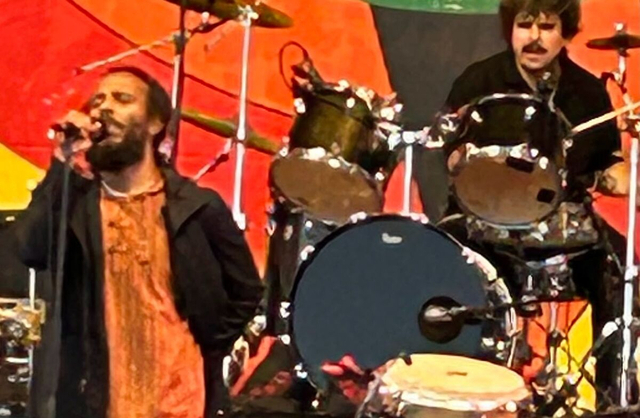
Jah, we give glory!
Just make a joyful noise and listen to the music play”
Jah, We Give Glory, Brightside, Ziggy Marley 2026
Without fanfare, Ziggy walked out to start the set with humility and grace. The crowd was ecstatic! There was immediate joy and relief, as people started dancing to the first track on his new album. Brightside’s “Jah, We Give Glory!” was an immediate mover. Ziggy laughed as he was singing the lyric ‘in the pouring rain’ with ironic surprise. People danced barefoot in the mud, couples slow danced in the rain, cheers of connection waved through the crowd. Drenched in peace and community, we are reminded of why we seek out live music in the first place.
For the first time at the 2026 New Orleans Jazz and Heritage Festival, Ziggy Marley premiered live, “Why Let The World." His new album, Brightside, was released just the day before and the performance featured several songs from the record, which people in the crowd seemed to already know. The new song features Trombone Shorty and Sheila E.
Also included in the set list was, “We are the People,” “Is This Love? (Bob Marley and The Wailers)” “Circle of Peace” “High on LIfe” “Justice/War/Get Up Stand Up” “Small Axe (The Wailers)” “Love Is My Religion” “Jammin” (Bob Marley and The Wailers), “Look Who’s Dancing,” “Tomorrow People.”
Ziggy Marley is embarking on tour to promote his new record, “Brightside” which is a testament to staying positive, true to yourself and bringing people together despite adversity. He will be sharing the stage with Burning Spear, Zuri Marley, Stephen Marley, J Boog and Trombone Shorty & Orleans Ave.
Press Release
David Nesta "Ziggy" Marley (born October 17, 1968, Trenchtown) is a Grammy-winning Jamaican musician. He is the oldest son of Rita and Bob Marley, the legendary roots reggae singer. His mother Rita called and baptised him David, but his father Bob nicknamed him "Ziggy" in reference to his childhood nickname. Born in Saint Ann Parish, Jamaica, Marley learned how to play guitar and drums from his father. A native of Kingston, Jamaica, Ziggy Marley first sat in on recording sessions with his father's band, legendary reggae troupe Bob Marley & The Wailers, when he was ten years old. Joining with his three siblings to become The Melody Makers, Ziggy crafted his own soulful sound blending blues, rnb, hip-hop and roots reggae. After their first two albums, Play The Game Right (1985) and Hey World! (1986), The Melody Makers earned their first Grammy (Best Reggae Recording) for Conscious Party (1988), an album produced by Talking Heads Chris Frantz and Tina Weymouth which included the hit songs "Tomorrow People" and "Tumbling Down." Subsequent albums included the Grammy-winning One Bright Day (1989), Jamekya (1991), Joy and Blues (1993), Free Like We Want 2 B (1995), their third Grammy winner Fallen is Babylon (1997), Spirit of Music (1999) and Ziggy Marley & the Melody Makers Live, Vol 1 (2000), which featured some of their biggest hits as well as a cover of Bob Marley's "Could You Be Loved." While selling records by the millions and selling out countless concerts with the Melody Makers, including a European tour, Ziggy Marley has never lost sight of his foundation of faith, fellowship and family. After two decades as the driving creative force behind The Melody Makers, Ziggy stepped out on his own with his first solo album, Dragonfly (2003). Never content to rehash the success of his past, Ziggy used Dragonfly to explore new ground and create his own distinctive musical identity as a solo artist. "Working on my own gave me a chance to take my time and experiment a lot," Ziggy says of the material on Dragonfly." It took one year to finish this record. It's the longest I've ever worked on an album. It's different when you are on your own. At some point it's scary and then at another it's a drive that makes you focus more." Although the members of the most close-knit musical families often yearn to step out on their own, for Ziggy, a solo debut was not a long-awaited goal. "It's not something that I wished for since I began doing music," he says. "It was just the circumstances, and I wanted to be true to myself and what I feel. The record has strong messages and it feels good." In addition to being Ziggy's first album of solo material, for Dragonfly he felt it was time for a change of scene. "Usually we record in Kingston. These songs were written in Jamaica and recorded in America. I did the first set of recordings in a house in Miami and then went to L.A. rented a house, set up my equipment and basically did the rest there. I left Jamaica for a while, because as an artist I need to experience different things, to see the world and have different energies. Living in one place is not good for me and I was tired of making music in a studio setting. I wanted it to be more like everyday life a part of me. "As an individual, I've opened up more by traveling outside Jamaica, and I've been more able to be open to people and ideas. It helps me to grow as a person to be outside of my element; to be on my own in a strange place meeting people. That's good for me not to be in my secure domain." The evidence of that growth is everywhere on Dragonfly. On July 2nd, 2006, Ziggy released his second album, Love is My Religion. He states "This album is from my heart," and he feels that he embraces his spiritual and emotional side of life. This album shows Ziggy coming into his own as an artist, as he wrote all of the songs for the album and played nearly all of the instruments. Love is My Religion is a testament to Ziggy Marley's talent as he follows in the footsteps of his father, the Legend.